
If a solar salesperson has knocked on your door lately, you've probably heard some version of "the government pays for a third of it." That was true for years. It isn't anymore — at least not the way it's usually implied — and the difference is worth thousands of dollars.
This isn't an article for or against solar. Depending on your roof, your utility rates, and how long you plan to stay in your home, panels can be a genuinely good purchase. But solar is sold hard, often at the kitchen table, often with urgency that doesn't survive contact with a calculator. Here's how to read the quote in front of you.
The tax credit changed — make sure your quote knows it
The federal residential clean energy credit (the 30% tax credit homeowners claimed when they bought a system with cash or a loan, known as Section 25D) ended for systems installed after December 31, 2025, under the budget law passed in July 2025. If you purchase a system in 2026, there is no federal tax credit for you to claim on it.
There's a wrinkle that sales pitches lean on: a separate business credit (Section 48E) still exists, and it can apply when a company — not you — owns the panels on your roof, as in a lease or power purchase agreement, currently through 2027. In those arrangements the credit goes to the solar company. A good company passes some of that value through in your monthly rate; a less good one simply keeps it while telling you "the tax credit makes this work."
So when a quote mentions federal incentives, ask one blunt question: "Who claims that credit — me or you?" In 2026, for a homeowner-purchased system, the honest answer is "no one." State and local incentives still vary widely — check the DSIRE database or your state energy office rather than taking the salesperson's word.
Own, borrow, lease, or PPA — know which contract you're actually reading
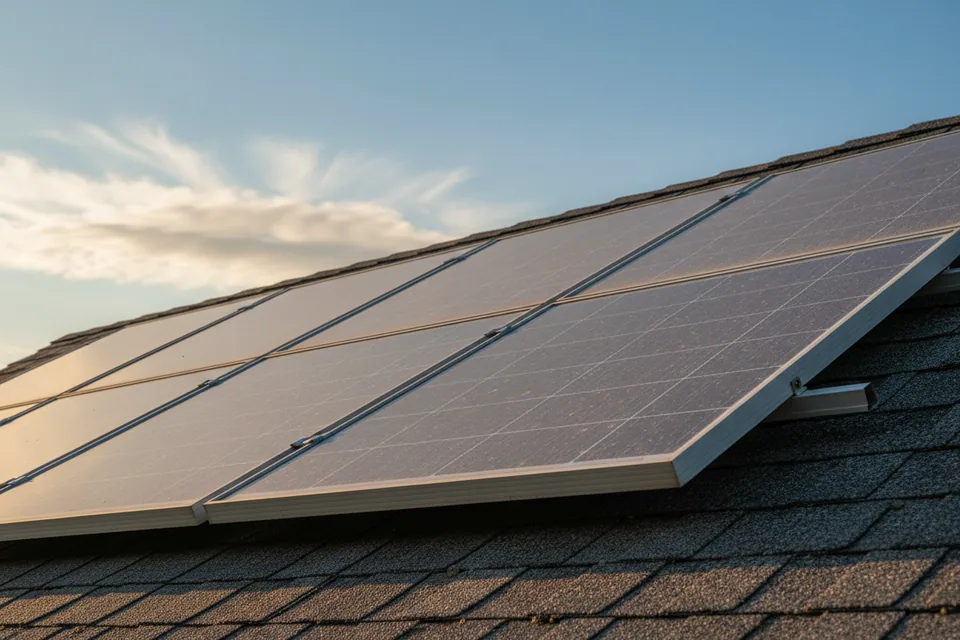
Every solar quote is one of four deals, and they age very differently:
- Cash purchase. You own the system. Highest upfront cost, simplest math, best long-term return if you stay put.
- Solar loan. You own the system, a lender owns you for 10–25 years. Watch for dealer fees baked into the price — the loan's "low rate" is often subsidized by inflating the system cost.
- Lease. The company owns the panels; you pay a fixed (or escalating) monthly fee.
- Power purchase agreement (PPA). The company owns the panels; you buy the electricity they produce at a set per-kilowatt-hour rate.
Leases and PPAs put nothing down, which is exactly why they're pitched hardest. The tradeoff: you don't own the asset, the contract typically runs 20–25 years, and it's attached to your house. If you sell, the buyer must qualify for and agree to take over the contract — a real friction point in a home sale. Ask, in writing, what it costs to buy out or terminate the agreement early.
The escalator clause is where the money hides
Many lease and PPA contracts include an escalator: an automatic annual increase in your payment, commonly in the 2–3% per year range. It sounds trivial. Compounded over 25 years, it isn't — a payment with a ~3% annual escalator roughly doubles by the end of a 25-year term. The pitch compares this year's solar payment to this year's utility bill and lets you assume utility rates will rise faster than the escalator. Maybe they will. But that's a bet, and you should know you're making it.
The pitch compares this year's solar payment to this year's utility bill and lets you assume utility rates will rise faster than the escalator.
Find the escalator in the contract yourself — don't ask whether one exists, ask where it is. If the answer is vague, that tells you something too.
Read the production numbers like a skeptic
A quote's savings projection rests on assumptions you're allowed to challenge:
- Estimated production. Based on your roof's orientation, shading, and local sun. Ask for the assumptions, and ask whether the contract includes a production guarantee — and what the company owes you if the system underdelivers.
- Your utility's credit for excess power. How your utility credits solar power you send back to the grid (often called net metering or net billing) varies enormously by state and utility, and the rules have been changing. The quote's savings math depends on it. Verify the current policy with your utility directly, not the installer's slide deck.
- The comparison bill. Confirm the projection uses your actual 12-month usage history, not a "typical household."
Slow the process down — you're allowed
The FTC's consumer guidance on home solar recommends comparing multiple quotes and treats high-pressure tactics as a warning sign in their own right. If the deal is only good "today," it was never good. And for door-to-door sales specifically, the FTC's Cooling-Off Rule generally gives you three business days to cancel a sale made in your home — the seller is required to tell you about that right and give you a cancellation form.
Before You Sign Anything
- Get at least three itemized quotes for the same system size, and compare price per watt
- Identify which deal structure it is: purchase, loan, lease, or PPA
- Find the escalator clause yourself and calculate year-20 and year-25 payments
- Ask who claims any tax credit — in 2026, a homeowner purchase gets no federal credit
- Ask the loan provider to disclose any dealer fee built into the system price
- Confirm your utility's current policy for crediting excess solar power, directly with the utility
- Get the early-termination and home-sale transfer terms in writing
- Check the installer's license with your state, their years in business, and who services the warranty if they fold
- Sleep on it — a real deal survives a week
Solar rewards exactly the kind of buyer this magazine assumes you are: unhurried, numerate, and immune to kitchen-table urgency. The panels don't care when you sign. Make the paperwork earn it.


